
Pattern recognition vs responsibility
Every few months, someone declares that AI is about to replace sysadmins. The tooling changes, the buzzwords rotate, but the anxiety cycle stays the same. Scripts were supposed to do it. Then configuration management. Then “the cloud.” Now it’s AI.
That framing is wrong.
AI isn’t coming for sysadmins.
It’s coming for people whose job was pattern recognition, not responsibility.
And those are very different things.
What AI Is Actually Good At
AI excels at:
- Pattern matching
- Recall across massive datasets
- Summarising state
- Suggesting likely next actions
- Automating known workflows
That’s powerful. No serious admin should pretend otherwise.
Feed an LLM logs, configs, change history, and topology diagrams, and it will:
- Spot correlations faster than a human
- Suggest probable root causes
- Generate workable scripts
- Recall vendor‑specific quirks you forgot existed
That’s not science fiction — it’s already happening.
But here’s the part that gets glossed over: none of that is ownership.
Pattern Recognition ≠ Responsibility
A good sysadmin isn’t defined by how fast they recognise patterns.
They’re defined by:
- Understanding blast radius
- Knowing what not to automate
- Judging when reliability beats elegance
- Making trade‑offs under incomplete information
- Being accountable when the fix goes wrong
AI can tell you what usually works.
It cannot own what happens when it doesn’t.
When production is down, the question isn’t:
“Who found the answer fastest?”
It’s:
“Who understands this system well enough to take responsibility for the decision?”
And that distinction matters more than ever.
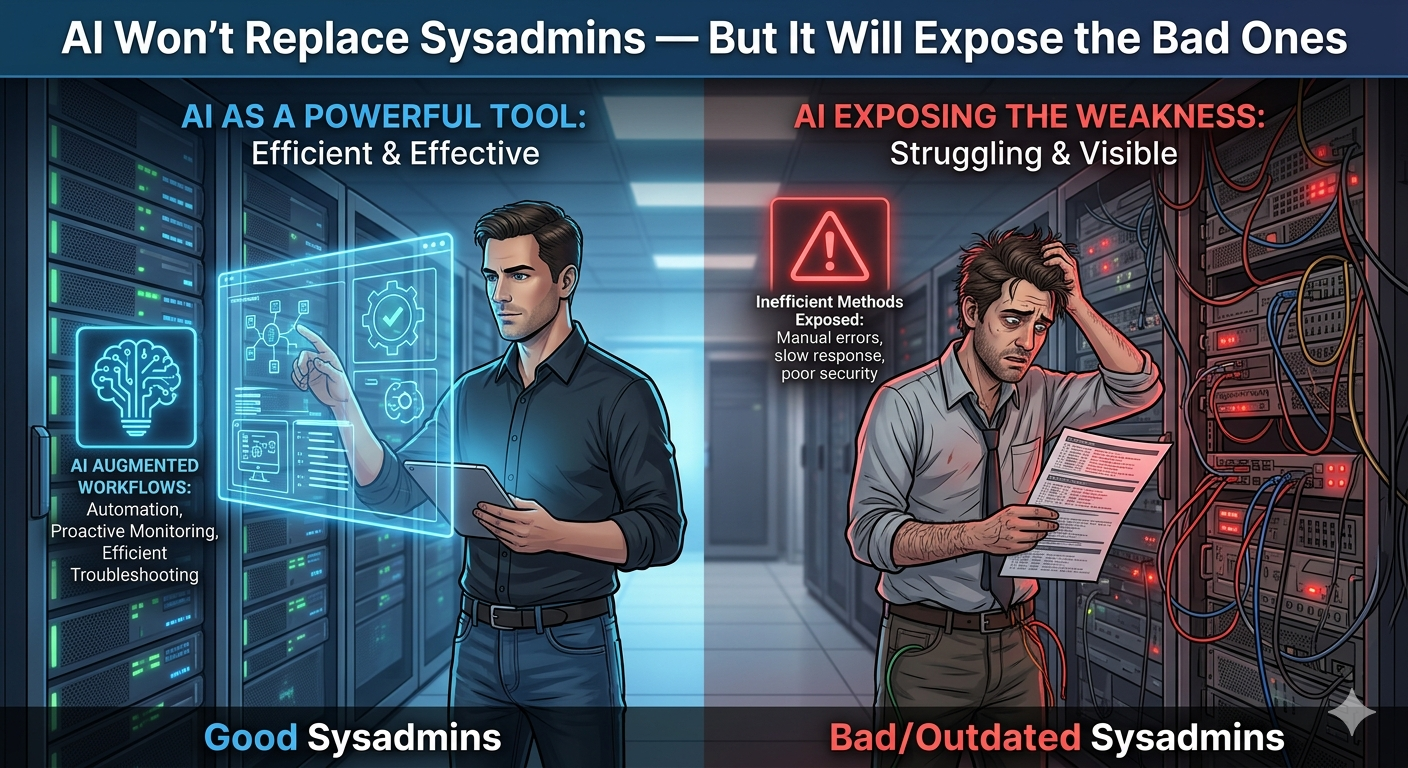
The Sysadmins Who Should Be Nervous
If your day‑to‑day work looks like:
- Copying patterns from previous tickets
- Following runbooks without understanding why they exist
- Reliably executing procedures you didn’t design
- Googling vendor docs and pasting commands
Then yes — AI is about to eat a huge chunk of that role.
Not because you’re bad at IT, but because your job was already mostly pattern replication.
AI doesn’t eliminate the role.
It commoditises that layer of work.
And organisations will absolutely notice.
The Sysadmins Who Will Thrive
If instead you:
- Understand system intent, not just configuration
- Know how components fail, not just how they start
- Think in failure domains, not checklists
- Push back on bad architecture before it’s implemented
- Treat automation as an extension of judgement, not a replacement
Then AI makes you more dangerous (in the good way).
You stop spending time:
- Writing boilerplate
- Translating mental models into configs
- Chasing logs across disconnected systems
And you spend more time:
- Designing systems that fail predictably
- Choosing where automation should stop
- Seeing second‑ and third‑order effects before incidents happen
AI doesn’t replace you — it removes the noise around your actual value.
The Real Exposure: Bad Thinking, Not Bad Typing
The quiet shift AI brings isn’t job loss — it’s exposure.
It exposes:
- People who never understood the systems they “managed”
- Teams that confuse tool adoption with architecture
- Organisations where no one really knows why things are designed the way they are
When an AI can generate a “correct” firewall rule, Terraform module, or PowerShell script in seconds, the differentiator isn’t can you write it?
It’s:
- Should this exist at all?
- Where does it break?
- What happens at scale?
- What happens when one dependency lies?
Bad answers to those questions were hidden before.
They’re obvious now.
Responsibility Is Not Automatable
Here’s what AI still can’t do — and likely won’t for a long time:
- Take the 3am call and decide to roll back vs push forward
- Explain risk in plain language to leadership
- Choose availability over security (or vice versa) consciously
- Accept accountability when the “correct” fix causes real damage
Those aren’t technical problems.
They’re human responsibility problems.
And sysadmins who see themselves as system owners — not button‑pushers — are safe.
The Job Isn’t Disappearing. It’s Narrowing.
What’s going away:
- Cargo‑cult admin work
- Low‑context operations
- “I just follow the doc” roles
What’s becoming more valuable:
- Systems thinking
- Failure modelling
- Cross‑domain understanding (identity + network + cloud + security)
- Clear technical judgement under pressure
AI compresses the middle.
It widens the gap between operators and owners.
The Choice in Front of Us
AI is going to sit next to every admin whether they like it or not.
The choice isn’t:
“Will AI replace sysadmins?”
It’s:
“Do you want to be the person who uses AI to make better decisions — or the person whose job was making decisions AI can now suggest?”
One of those roles is expanding.
The other is shrinking fast.
And the exposure has already started.
Comments are closed