
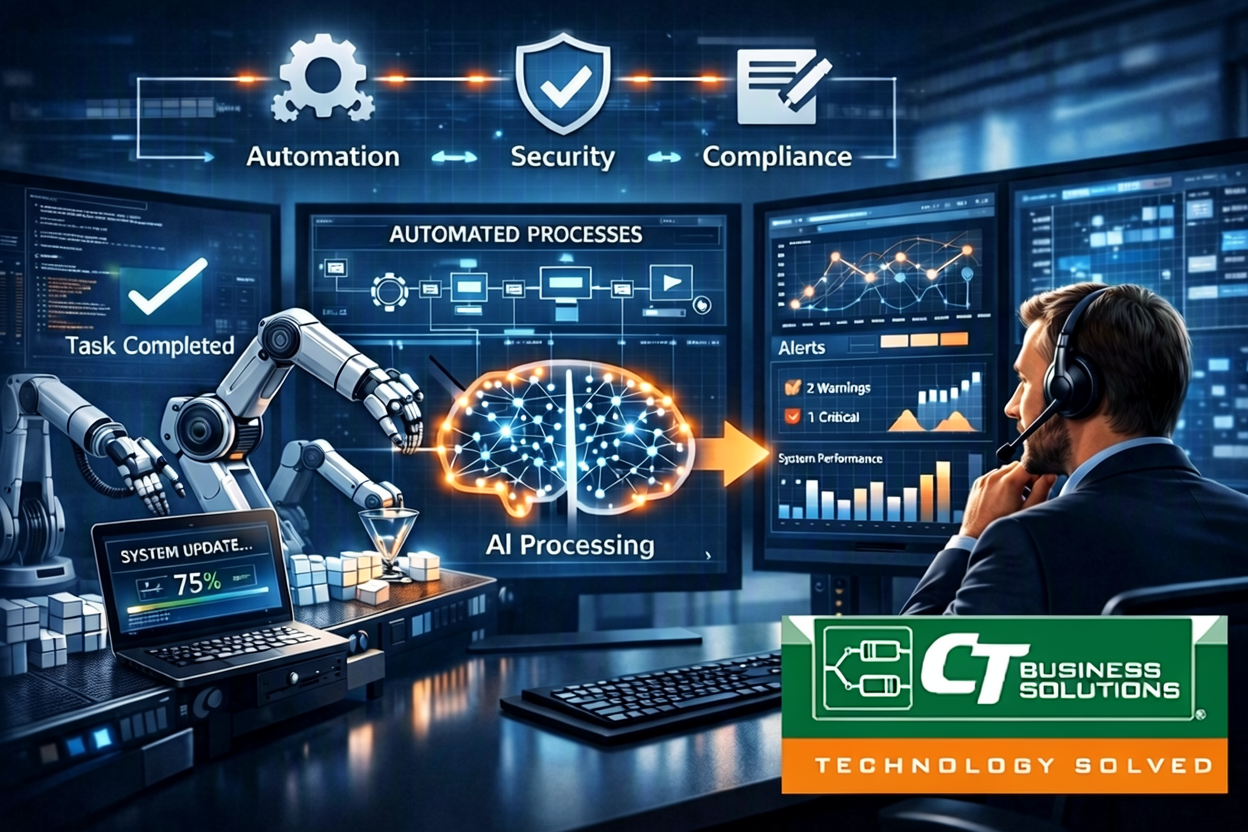
Automation continues to fundamentally transform IT operations, shifting engineering teams away from tedious manual execution toward high-value architecture and strategic innovation. Modern automation frameworks allow organisations to streamline repetitive, high-frequency workflows—such as patch management, server provisioning, and routine system health checks—while maintaining absolute visibility and approval control.
This careful equilibrium between speed and security ensures efficiency gains do not compromise compliance, security posture, or accountability. For enterprise-grade IT environments, deploying automation without governance is an operational hazard; true maturity requires building robust guardrails into the software pipeline.
The Evolution of IT Operations
Historically, IT departments relied on manual runbooks, ad hoc shell scripts, and tribal knowledge held by individual engineers. While functional in smaller environments, this model scales poorly. As infrastructure footprints expand into hybrid and multi-cloud architectures, manual intervention introduces human error, deployment drift, and extended Mean Time to Resolution (MTTR).
Modern automated IT operations leverage Infrastructure as Code (IaC), continuous configuration management, and event-driven orchestration platforms. These technologies execute standardised tasks in seconds rather than hours. However, total unmonitored autonomy (“full-auto”) frequently leads to catastrophic outages when edge cases bypass rigid script parameters.
“Automation should eliminate toil, not responsibility. The goal is to remove repetitive labor while keeping human judgment firmly in the critical path where risk assessment is required.”
Core Pillars of Governed Automation
To successfully deploy automation without losing operational oversight, engineering leaders must architect their workflows around four foundational principles:
- Declarative State & Version Control: All automation logic, playbooks, and templates must reside in version-controlled repositories (e.g., Git). Changes must undergo peer review via pull requests before reaching production environments.
- Human-in-the-Loop (HITL) Gates: Critical operational triggers—such as database schema modifications, production kernel updates, or IAM permission grants—must pause for explicit authorisation from a designated engineer or change manager.
- Comprehensive Observability & Audit Trails: Every automated action must emit structured logs, telemetry data, and state changes to a centralised SIEM or logging platform, establishing a clear forensic chain of custody.
- Automated Rollback Mechanisms: Scripts and deployment tools must support deterministic failure detection that automatically reverts changes or halts execution if health checks fail.
Comparing Operational Models
Understanding the operational trade-offs clarifies why human-governed automation represents the gold standard for enterprise IT.
| Operational Model | Speed | Error Rate | Compliance Risk | Human Burden |
|---|---|---|---|---|
| Manual Execution | Low | High | High | High (Toil-heavy) |
| Unchecked Automation | Very High | Medium-High | Critical | Low (Until incident) |
| Governed Automation (HITL) | High | Low | Minimal | Optimised (Strategic approval) |
Practical Implementation Strategies
Implementing a governed automation framework requires a deliberate phased rollout. Organisations should begin by identifying high-frequency, low-risk operational tasks—such as generating disk-space reports or cycling temporary cache services—and automating them entirely with passive logging.
Once stability is proven, teams can introduce semi-automated workflows for intermediate tasks like non-production patching. For high-risk production activities, implementation must enforce mandatory approval steps directly integrated into enterprise service management (ITSM) tools like ServiceNow or Jira Service Management.
Conclusion
The maturation of IT operations does not mean replacing human expertise with autonomous systems; it means amplifying human capability through intelligent tooling. By embedding governance, approval gates, and clear visibility into automated pipelines, organisations achieve the speed required by modern business demands while safeguarding the stability and security of the enterprise.
“Automation should eliminate toil, not responsibility. The goal is to remove repetitive labour while
keeping human judgment firmly in the critical path where risk assessment is required.”
Core Pillars of Governed Automation
To successfully deploy automation without losing operational oversight, engineering leaders must architect
their workflows around four foundational principles:
Declarative State & Version Control: All automation logic, playbooks, and templates must reside in
version-controlled repositories (e.g., Git). Changes must undergo peer review via pull requests before
reaching production environments.
•
Automating Routine IT Tasks Without Losing Human Oversight 1
Human-in-the-Loop (HITL) Gates: Critical operational triggers—such as database schema modifications,
production kernel updates, or IAM permission grants—must pause for explicit authorisation from a
designated engineer or change manager.
Comprehensive Observability & Audit Trails: Every automated action must emit structured logs,
telemetry data, and state changes to a centralised SIEM or logging platform, establishing a clear forensic
chain of custody.
Automated Rollback Mechanisms: Scripts and deployment tools must possess deterministic failure
detection capable of automatically reverting changes or halting execution if health checks fail.
Comparing Manual, Unchecked, and Governed Automation
Understanding the operational trade-offs clarifies why human-governed automation represents the gold
standard for enterprise IT.
Operational Model Speed Error Rate
Compliance
Risk
Human Burden
Manual Execution Low High High High (Toil-heavy)
Unchecked Automation
Very
High
Medium-
High
Critical Low (Until incident)
Governed Automation
(HITL)
High Low Minimal
Optimised (Strategic
approval)
Practical Implementation Strategies
Implementing a governed automation framework requires a deliberate phased rollout. Organizations should
begin by identifying high-frequency, low-risk operational tasks—such as generating disk-space reports or
cycling temporary cache services—and automating them entirely with passive logging.
Once stability is proven, teams can introduce semi-automated workflows for intermediate tasks like non-
production patching. For high-risk production activities, implementation must enforce mandatory approval
steps directly integrated into enterprise service management (ITSM) tools like ServiceNow or Jira Service
Management.
Conclusion
The maturation of IT operations does not mean replacing human expertise with autonomous systems; it
means amplifying human capability through intelligent tooling. By embedding governance, approval gates, and
clear visibility into automated pipelines, organisations achieve the speed required by modern business
demands while safeguarding the stability and security of the enterprise.
Comments are closed