
Why Data Quality Determines AI Success in Modern IT Environments
Artificial intelligence has become integral to modern IT operations, driving automation, analytics, and decision‑making across every layer of infrastructure. Yet the effectiveness of these systems depends entirely on the quality of the data they consume. High‑quality, well‑structured data enables accurate predictions, reliable automation, and meaningful insights. Poor data quality, on the other hand, leads to inconsistent behaviour, wasted resources, and increased operational risk.
The Foundation of Reliable AI
AI models learn patterns from data — not from assumptions. When that data is incomplete, duplicated, or inconsistent, the model’s outputs become unreliable. In enterprise environments, this can translate into flawed forecasts, misdirected automation, or even compliance breaches. Establishing strong data governance ensures that every dataset entering the AI pipeline meets defined accuracy and integrity standards.
Building Strong Data Pipelines
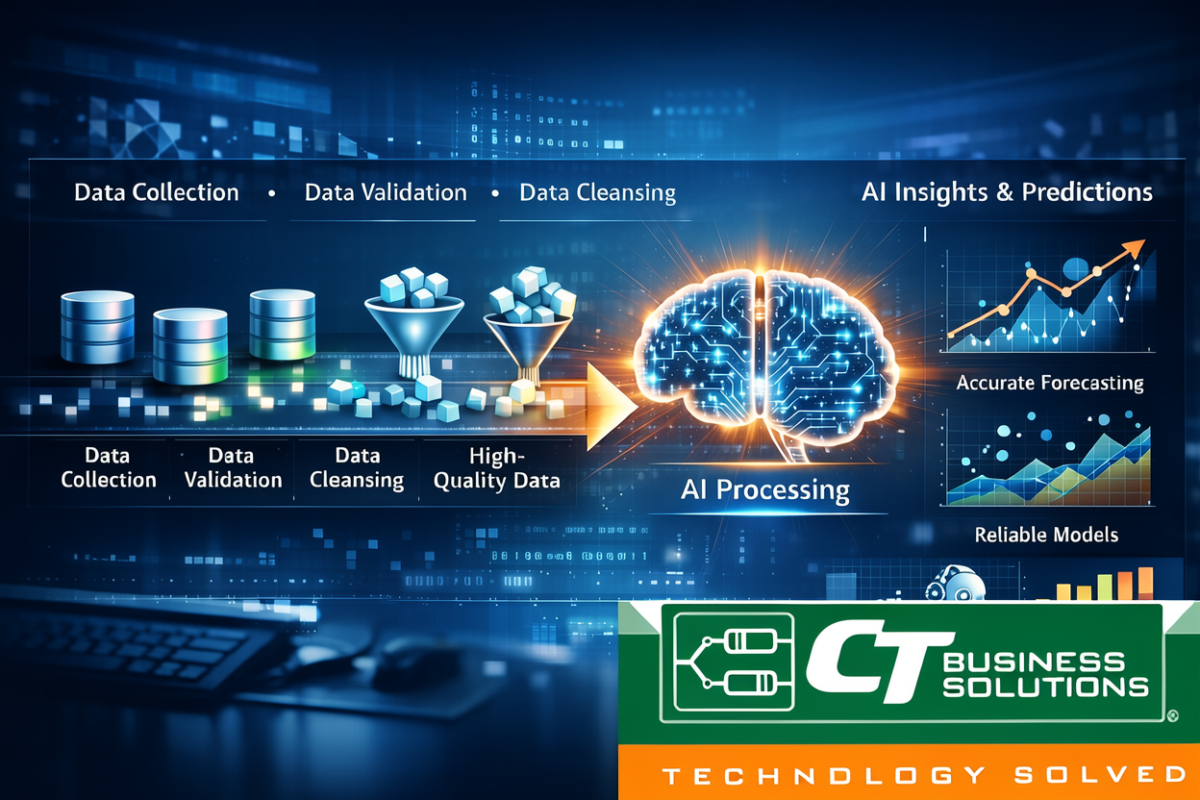
A robust data pipeline is more than a technical construct; it’s a framework for trust. Key stages include:
- Data validation: Verifying that incoming data meets schema and format requirements.
- Data cleansing: Removing duplicates, correcting errors, and standardising values.
- Data enrichment: Integrating contextual information to enhance analytical depth.
- Data governance: Applying policies that define ownership, access, and lifecycle management.
Together, these processes ensure that AI systems operate on a foundation of truth rather than noise.
Operational and Strategic Impact
Organisations that invest in data quality gain measurable advantages:
- Predictive accuracy: Models trained on clean data deliver more consistent outcomes.
- Automation reliability: Workflows execute correctly without manual correction.
- Risk reduction: Fewer false positives and compliance errors.
- Decision confidence: Executives can act on insights knowing they’re grounded in verified data.
Conclusion
Data quality isn’t a technical afterthought — it’s a strategic asset. As AI becomes embedded in every facet of IT operations, the organisations that prioritise validation, cleansing, and governance will achieve the most reliable automation and the most meaningful insights. In short, data quality is the difference between AI that merely functions and AI that truly performs.
Comments are closed